The tell-tale signs you were taught — bad grammar, weird urgency, generic greetings — are gone. The new generation of phishing doesn’t just write well. It answers your questions.
Key Takeaways
- Phishing campaigns in 2026 increasingly use AI agents that hold interactive conversations instead of firing one static email.
- Some campaigns add deepfake audio that impersonates executives, vendors — or you.
- Security researchers report AI-generated phishing now outperforms human red teams at getting clicks.
- The defense is not smarter detection on your part. It’s a process that doesn’t rely on you detecting anything.
The Email That Replies
Here’s what a current-generation phishing attack looks like for an online business owner.
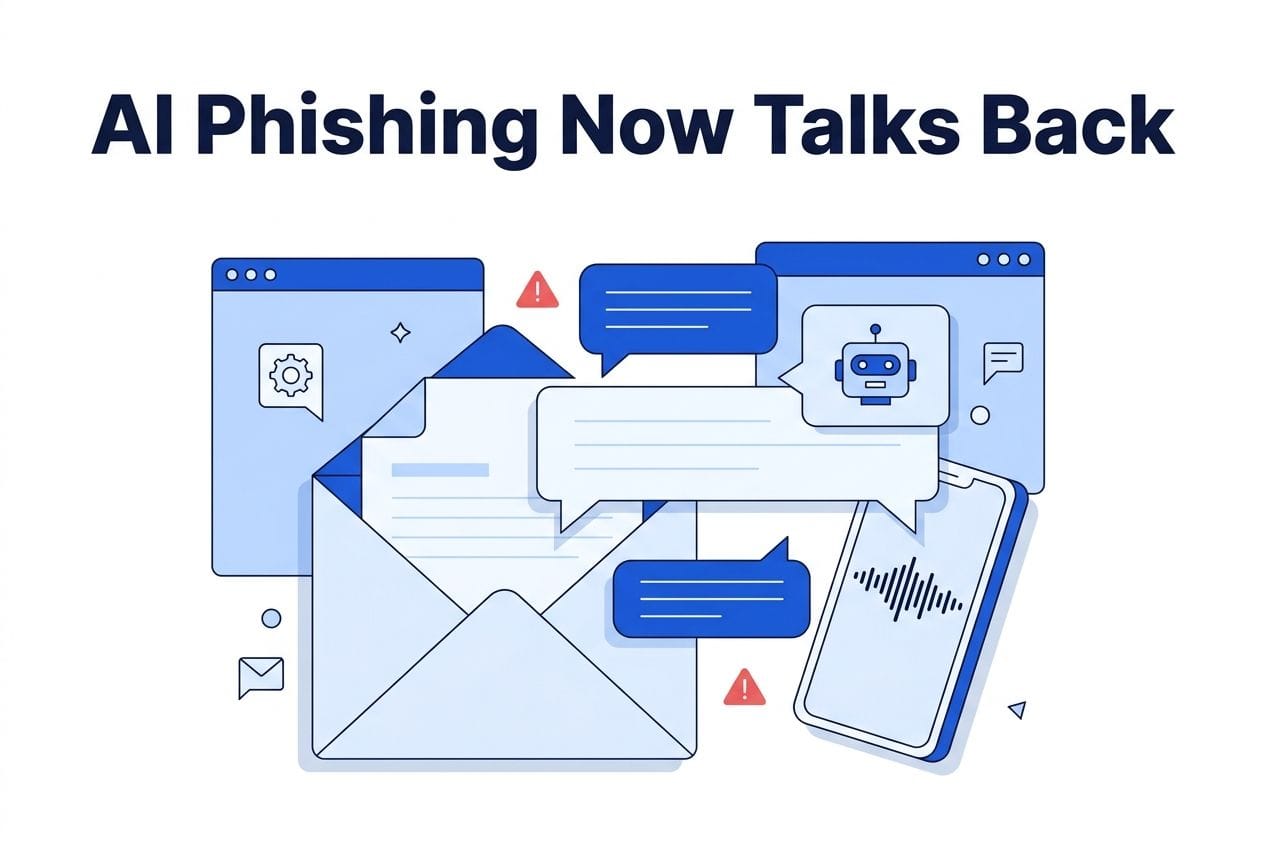
You get an email from what looks like a payment platform you actually use. It references a real-sounding transaction problem. You’re suspicious — good — so you reply and ask a question. And it answers. Correctly, politely, in context. You ask another. It answers again, and mentions it can sort this out on a quick call. Then your phone rings and a calm, professional voice walks you through “verifying” your account.
None of that involved a human attacker. The email, the chat replies, the voice — agent-driven, end to end. Researchers tracking this through 2026 report that advanced campaigns no longer send poorly written emails; they initiate conversations via chatbots that can hold convincing dialogue, and some layer in deepfake audio of known executives.
The reason this matters for small operators: the marginal cost of running a patient, conversational scam used to be human hours. Now it’s tokens. Nobody was going to spend three days of skilled labor phishing a one-person affiliate business. An agent will happily spend three weeks.
Why “Just Be Careful” Stopped Working
Your entire phishing education was pattern-matching: spot the typo, hover the link, notice the urgency. That worked when scams were mass-produced junk.
AI-generated phishing has been shown to outperform human red teams — the professionals paid to trick employees for a living. If trained security testers are being beaten by the tooling, “I’d notice” is not a plan. I’ve written before about how LLMs and AI agents are reshaping the attacker’s side — phishing is simply where it reaches you personally.
And small teams are the preferred target, not the overlooked one. You have the same money-moving accounts as a bigger company — Stripe, PayPal, your bank, your domain registrar — with none of the approval bureaucracy that slows an attacker down. One person who trusts one conversation can move money or hand over a login in minutes. Automated attacks don’t check your revenue before they fire.
The Defense: Make Detection Irrelevant
You cannot out-read a machine that writes better than you. So stop competing. Build rules that work even when the message fools you completely.
1. One verification rule for money and passwords. Any request that touches payments, payouts, or credentials gets verified through a second channel you initiate — you call the known number, you log in by typing the address yourself. No exceptions for urgency. Especially for urgency.
2. Phishing-resistant two-factor on the accounts that hold money. Passkeys or hardware keys where possible. SMS codes can be phished by exactly the conversational attacks described above; a passkey can’t be sweet-talked.
3. A code word for voice. If you work with a VA, a partner, or family who can authorize anything: agree on a spoken code word for unusual requests. Deepfake audio clones a voice, not shared secrets.
4. Clean up who’s already inside. Conversational phishing often aims to get an app authorized, not a password typed. Review your connected apps quarterly — I broke down why in the connected-app problem.
5. Slow down the inbox that can spend money. Separate the email address that controls your financial accounts from the one printed on your website. The address attackers can find shouldn’t be the one that can reset your bank password.
Do It Once, Properly
Every step above is part of a bigger pattern: boring, one-time setup beats vigilance forever. If you want the complete click-by-click version — covering your inbox, WordPress site, connected apps, and the AI tools you run your business on — that’s exactly what the Weekend Lockdown Plan is: five lessons, twenty-two actions, one weekend, $9.95.
Want to start smaller? The free 15-Point AI Security Checklist covers the first afternoon.
FAQ
Can AI phishing emails really hold a conversation?
Yes. Current campaigns use agent-driven chatbots that reply in context, answer questions, and escalate to voice calls — no human attacker needed for most of the exchange.
How do I recognize an AI phishing email?
Increasingly, you don’t — grammar and context are now flawless. That’s why the practical defense is process-based: verify money and credential requests through a second channel you initiate, regardless of how legitimate the message looks.
Is SMS two-factor authentication still safe?
It’s better than nothing, but SMS codes can be extracted through convincing conversational phishing. For accounts that hold money, upgrade to passkeys or hardware security keys.
What should I do if I already replied to a suspicious email?
Stop the conversation, don’t click anything sent to you, and change the relevant password by navigating to the site yourself. If money or credentials were shared, contact the platform and your bank immediately.
Are small businesses really targets for AI phishing?
Yes — automation makes targeting indiscriminate. Small businesses hold the same payment accounts as large ones, with fewer approval steps between an attacker and the money.
Sources
- StrongestLayer, AI-Generated Phishing: The Top Enterprise Threat of 2026
- Dark Reading, AI Phishing Is No. 1 With a Bullet for Cyberattackers
- The Hacker News, 2026: The Year of AI-Assisted Attacks
- KnowBe4, AI & Cybersecurity in 2026: Top 10 Predictions
Disclaimer: informational only, not professional cybersecurity, legal, or financial advice.