
What the last few weeks of AI-security headlines actually mean for a one-person online business, and the single weekend that closes the doors they walk through.
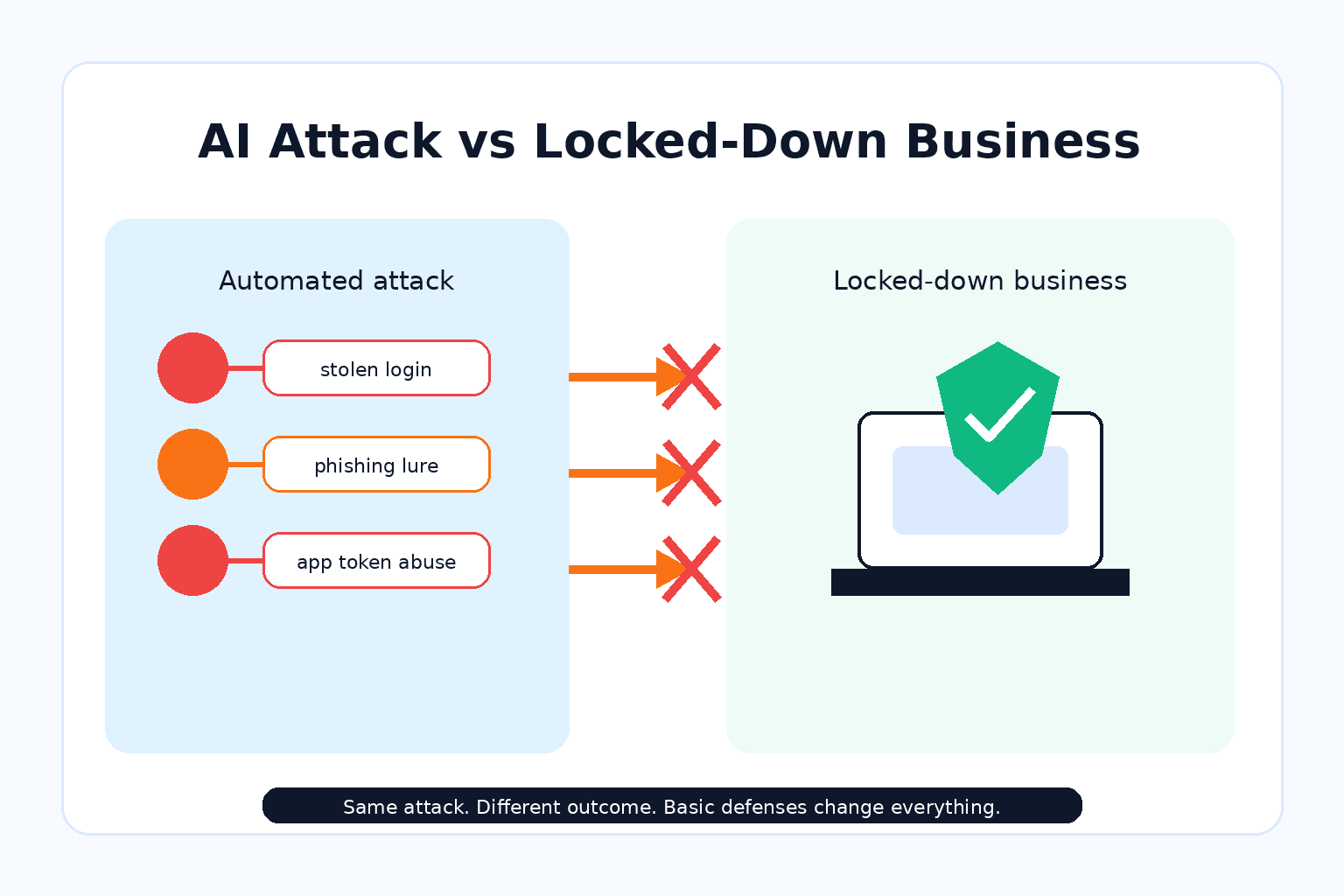
On May 10, 2026, security researchers documented something that used to be science fiction. An AI agent ran a cyberattack on its own. No human at the keyboard. It moved through four separate systems and reached the database in under an hour.
That was not a one-off.
Days earlier, GitHub confirmed that roughly 3,800 of its internal repositories were stolen because one employee installed a browser extension that was malicious for just 18 minutes.
Days later, researchers showed that asking ChatGPT to summarize a web page could plant a working phishing link inside ChatGPT’s own answer, styled to look like the assistant talking to you.
If you run your business from a laptop, that last detail should get your attention. Not because a nation-state is coming for you. Because none of these attacks needed one.
AI did not invent new ways to break in. It made the old ways cheap, fast, and automatic.
CrowdStrike’s 2026 Global Threat Report found AI-enabled attacks jumped 89% in a single year. The average attacker now spreads through a network in 29 minutes. The fastest on record did it in 27 seconds.
Automated means indiscriminate. The attack does not check your revenue before it fires. It sweeps everyone and keeps whoever left a door open.
That is why small businesses get hit harder, not softer. 88% of breaches at small and mid-sized businesses involve ransomware, against just 39% at large enterprises. Being small was never camouflage. It just means weaker doors.
And the cost does not scale down with your size. Microsoft puts the average investigation-and-recovery bill for a small-business attack at $77,957. For a solo operator, that is not a line item. That is the business.
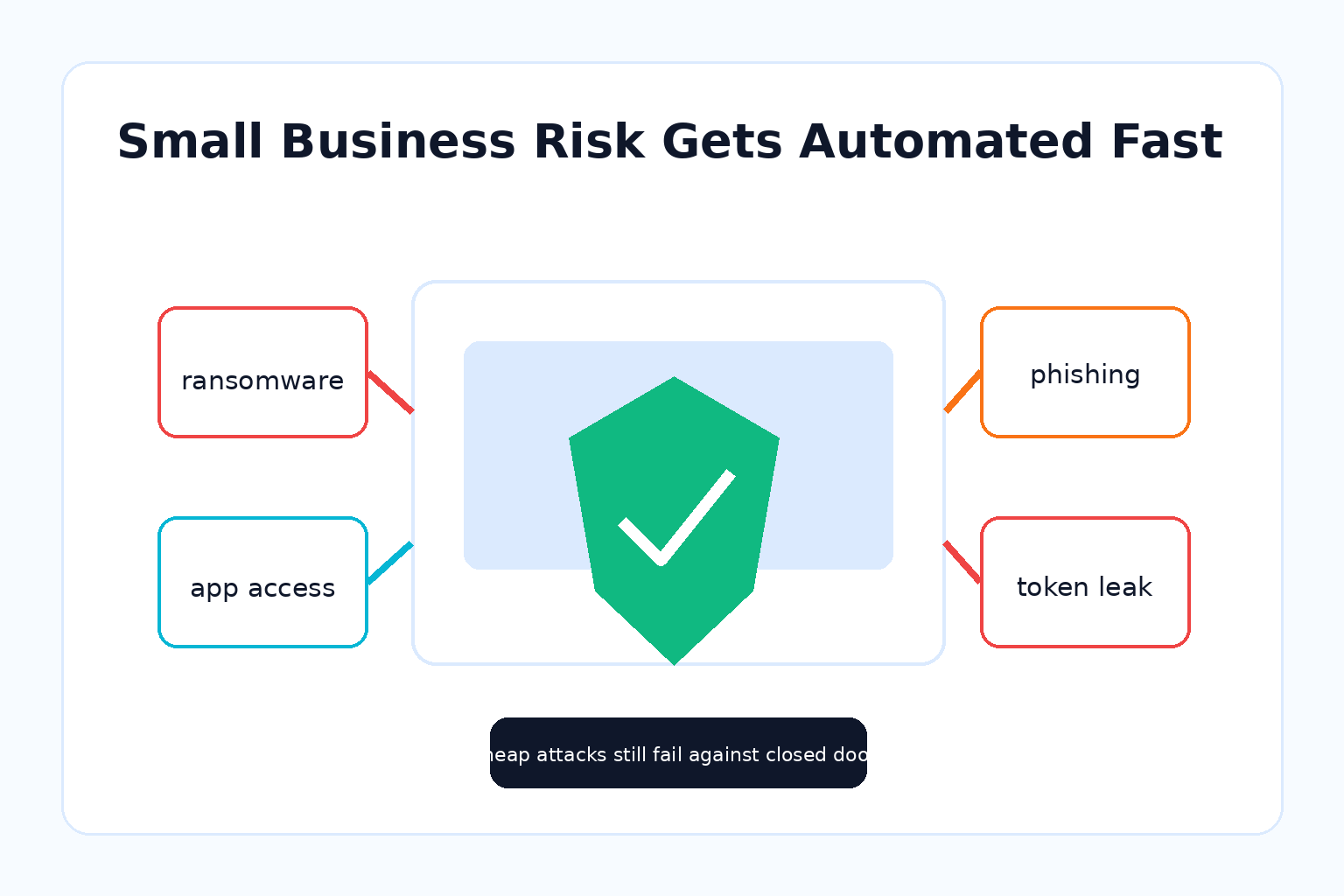
Most people react to this in one of two wrong ways
The first is despair: “I am not technical enough to beat this.” The second is denial: “I am too small, nobody is coming.”
Both are wrong. Both are expensive.
Here is what the headlines do not tell you. The defenses that stop these automated attacks are not enterprise software. They are the basics. One security advisor at Cisco called them the cyber veggies: boring, foundational, and dangerous to skip.
- the autonomous AI agent still needed a credential to get started
- ChatGPhish still needed you to trust a link
- the GitHub breach still came down to one device with too much access
Every one of them would have hit a wall against a business that did the boring stuff. The threats got automated. The defenses did not get harder. They got ignored.
51% of small businesses have no security measures in place at all. Not because owners do not care. Because it feels like a project with no ending, so it never gets a beginning.
So I built the ending. It is one weekend.
The Weekend Lockdown Plan is not a course you never finish. It is a single weekend, start to done.
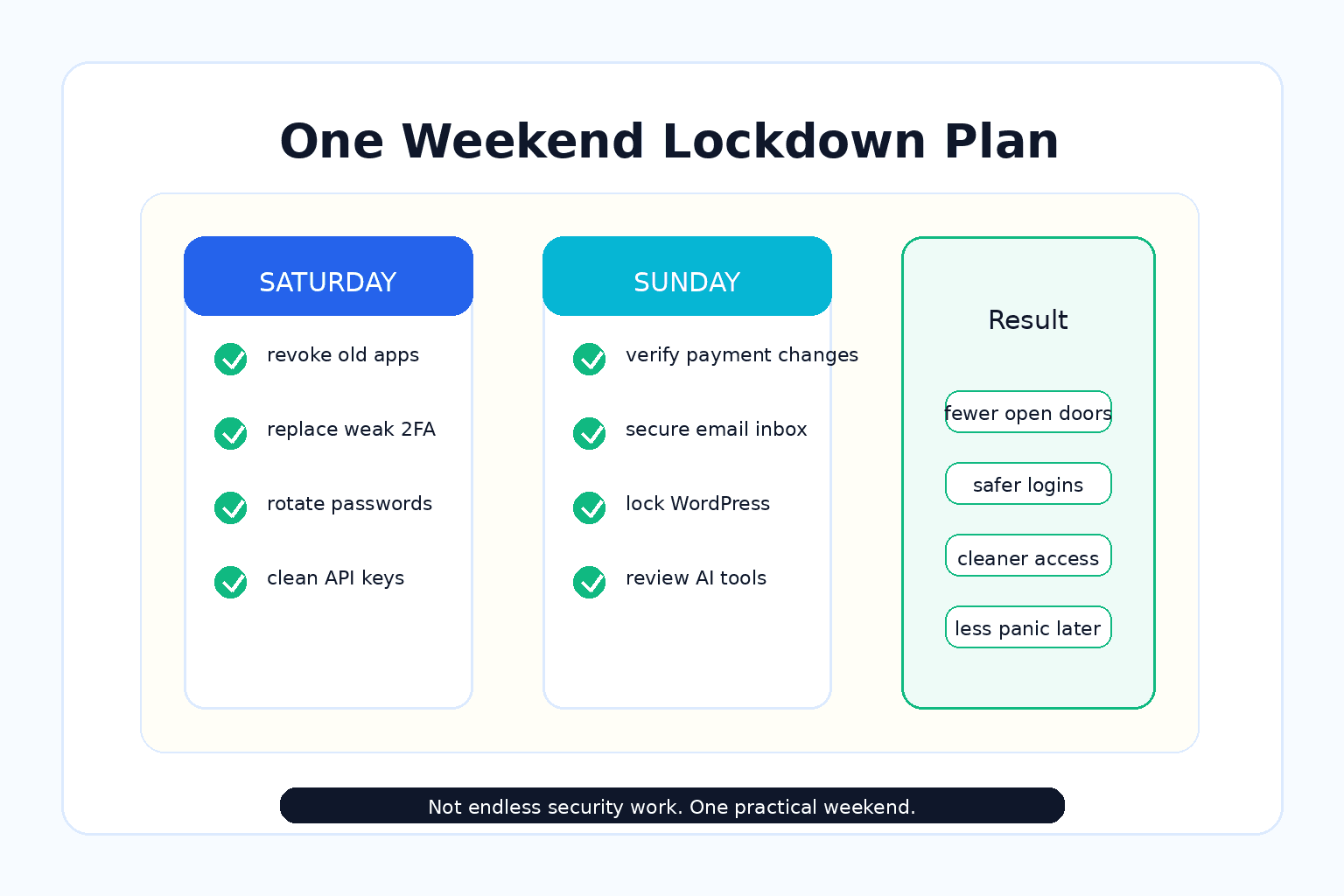
Five lessons. Twenty-two specific actions. Each one closes a door these automated attacks actually walk through:
- revoke the apps you connected once and forgot
- replace SMS codes with phishing-resistant two-factor on the accounts that hold your money
- get your API keys and passwords out of the places they quietly leak from
- put one verification step between a scary message and any payment or password change
- lock down the WordPress site, the inbox, and the AI tools you run the whole business on
No IT team. No jargon. No new monthly software bill. You sit down Saturday, work the list in order, and by Sunday night the easy doors are shut.
Do the math before you decide it is not worth it
The cleanup after a small-business attack averages $77,957 and, for many organizations, more than 100 days of disruption before full recovery.
The Weekend Lockdown Plan costs less than lunch and takes less time than finishing a series. This is the cheapest insurance you will ever buy, except it is not insurance. It is a lock on the doors you did not know were open.
The three objections, answered
“I am not technical.” That is exactly who it is for. Every step is click by click.
“I do not have time.” It is one weekend, one time. The doors stay closed after that.
“I am too small to be a target.” Re-read the 88% number. In an automated world, small is not overlooked. Small is selected.
Lock it down this weekend
The launch price is $9.95. That is on purpose. I would rather you actually do this than admire it from your bookmarks.
Get the Weekend Lockdown Plan here.
Want to start even smaller? Grab the free 15-Point AI Security Checklist. It is the first afternoon of the plan, on the house.
The attackers automated. Catching up still takes one weekend. Take it.
Sources
- Sysdig, AI agent-driven intrusion observed on May 10, 2026
- Permiso Security, ChatGPhish markdown rendering research
- Verizon, 2025 Data Breach Investigations Report
- IBM, Cost of a Data Breach 2025
Disclaimer: informational only, not professional cybersecurity, legal, or financial advice.


